A cabin near downtown Evergreen goes under contract in three weeks. A comparable property a few miles up Upper Bear Creek Road sits for four months. Same price range, same mountain setting, same buyer pool searching for Colorado foothills living. The gap is not about desirability. It is about what has to happen between an accepted offer and a closing on this specific stretch of road, and in 2026 that list of what has to happen just got longer.
Evergreen's overall market has been fast this year. Homes across the town sold for a median price of $888,000 over the three months ending in June 2026, moving in roughly 20 days on average. Upper Bear Creek runs on a different clock entirely. Over the trailing 12 months, the corridor's median sale price sat at $935,000, down 24 percent from the year before, with homes taking an average of 95 days to sell compared to a 54-day national average. A narrower slice of current listings shows the same pattern in sharper relief: a median asking price near $1.75 million and an average of 124 days on market.
Read those numbers as a verdict on the neighborhood and you'll draw the wrong conclusion. Read them as a measurement of diligence time and they start to explain themselves.
One Road, Several Different Transactions
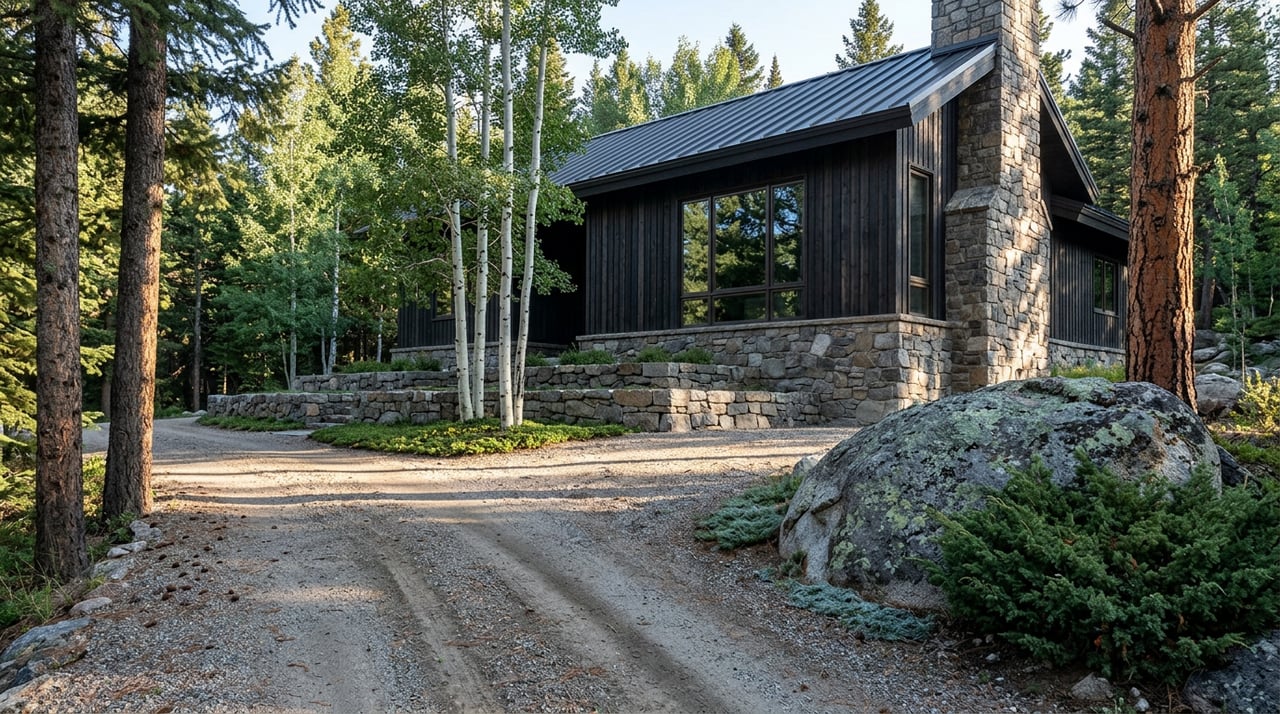
Upper Bear Creek Road is not a single, uniform product the way a subdivision is. Some parcels sit on public, county-maintained pavement. Others are reached by stretches where the road responsibility shifts to private hands and the surface turns to gravel before the final approach. One listing description put it plainly: the final stretch is unpaved, which adds privacy and limits through traffic, but it also means a title company and a lender are looking at a different access question than they would on a paved cul-de-sac in town.
The inventory itself spans an unusually wide range of eras and uses. A 65.6-acre parcel called Joy Ranch borders Denver Mountain Parks land near Elephant Butte Park, zoned for grazing with a domestic well already in place. An 844-acre property along Vance Creek, held by descendants of Colorado Governor John Evans since 1924, came to market this year for the first time in generations. A 1919-built estate known as Yankee Point changed hands after 37 years in the same family, with nearly 700 feet of creek frontage and two ponds on the grounds.
None of that is filler history. It matters to a timeline because century-old structures, legacy land holdings, and creek-adjacent acreage all carry their own layers of due diligence that a five-year-old subdivision home simply does not. A buyer comparing the median price here to the median price in town is comparing two different kinds of transactions wearing the same dollar sign.
The Insurance Letter That Changes the Contingency Period
The most consequential shift for anyone buying or selling on this corridor right now is not physical. It is regulatory, and it landed earlier this year, on July 1, 2026.
Colorado's House Bill 25-1182, signed into law in May 2025, now requires any insurer using a wildfire risk model to disclose that model and the resulting score to homeowners, and to factor documented mitigation work into pricing rather than relying only on broad geographic zones. A homeowner in a wildland-urban interface corridor like Upper Bear Creek can request their actual risk score and see what is driving their premium, and insurers are required to credit verified defensible space, Class A roofing, and similar hardening work when they calculate rates. But the disclosure itself arrives on a rolling basis, tied to each policy's individual renewal date rather than a single date for everyone. That means transactions closing through the rest of this year and into 2027 are the first wave to actually encounter the new notice, and the ones where sellers and buyers alike are still figuring out what to do with it.
That sounds like good news for sellers, and in the long run it likely will be. In the near term, it is adding a step to transactions that used to close faster. Buyers financing a purchase in a designated wildfire zone are increasingly asking for an insurance quote before they will remove a financing contingency, and in a market where carriers have already grown more selective about writing new policies in foothills communities, that quote can take longer to secure than it used to. Colorado's insurance commissioner has acknowledged as much publicly, noting that underwriting changes have created "coverage gaps in mountain communities like Evergreen and Conifer." A gap in coverage options is a gap in closing timelines.
For sellers, the practical takeaway is straightforward: if you have completed defensible space work, replaced a roof, or added ember-resistant vents, gathering dated photos and contractor invoices before you list gives a buyer's insurance search something concrete to work with instead of a blank slate. The Evergreen Metro area's wildfire prepared portal keeps a running list of local defensible space grant programs and assessment resources worth reviewing before that first showing.
Well, Septic, and the Second Clock Running in Parallel
Insurance is not the only diligence track running on this corridor. Most properties along Upper Bear Creek rely on a private well and a septic system rather than municipal water and sewer, though a handful of parcels closer to town do have public sewer service. Listing after listing along the road confirms the pattern: private well, septic tank, domestic well allowing for horses. That mix is part of what makes the setting what it is, but it also means a buyer's due diligence period has to accommodate a water quality and yield test, a septic inspection, and in some cases a permit review, all running on their own timeline separate from the insurance search.
When both tracks run at once, a 30-day close on a downtown Evergreen listing can reasonably stretch to 60 or 90 days on Upper Bear Creek, not because anyone is dragging their feet, but because there are simply more boxes to check before anyone can responsibly remove contingencies.
| Evergreen citywide | Upper Bear Creek corridor | |
|---|---|---|
| Median sale price | $888,000 (3 months ending June 2026) | $935,000 (trailing 12 months), down 24% year over year |
| Average days on market | 20 days | 95 to 124 days depending on the data window |
| Typical water and sewer | Mix of public and private systems | Mostly private well and septic |
| Road access | Predominantly public, paved | Mixed public and private, with unpaved stretches |
Reading 124 Days Correctly
The instinct when a property sits for four months is to assume something is wrong with it. On this corridor, the more accurate read is that four months is roughly what it takes to run an insurance search under a new disclosure regime and a well-and-septic inspection in parallel, especially if either one turns up something that needs a second look.
That reframing matters for both sides of a transaction. A seller pricing a legacy parcel or an older estate should expect the process to take longer than it would in a newer subdivision, and should build that expectation into how they plan a move rather than reading a slower pace of offers as a pricing problem. A buyer who understands the two clocks running in parallel can get ahead of both: requesting a wildfire risk score and preliminary insurance quote before writing an offer, and lining up a well and septic inspector early so results are in hand when the insurance piece resolves. Buyers who do this move faster than buyers who discover the timeline mid-contract.
None of this is a reason to avoid the corridor. Creek frontage, century-old structures with real history, and acreage bordering public land are not commodities you find in a standard subdivision search, and the people drawn to Upper Bear Creek tend to know exactly why they are there. The point is simpler: the days-on-market number and the recent price softening are telling you about the mechanics of closing here, not about how many people want to live here.
A Few Questions Worth Asking Early
Does every property on Upper Bear Creek Road have well and septic? Not universally, but it is the norm rather than the exception, and any listing you're seriously considering should specify both the water source and sewer type before you get far into a contract.
Is the HB 1182 disclosure already in effect, or is it still coming? The transparency requirement took effect July 1, 2026, but it reaches each homeowner on their own policy's renewal date rather than all at once. If your policy or your seller's policy hasn't renewed since that date, you may not have seen the new disclosure yet, so it's worth asking your insurance agent directly rather than assuming it already arrived.
Does road responsibility affect financing? It can. Whether a parcel's access is public and maintained or private and unpaved is the kind of detail a lender's underwriter will want documented, and it's worth confirming in writing before you're deep into a contract rather than discovering it at closing.
If you're weighing a purchase or a sale along this corridor, the timeline questions above are exactly where a conversation is more useful than a search filter. Yvette Putt has spent years walking Evergreen-area buyers and sellers through the specific mechanics of acreage, well and septic, and legacy-property transactions like the ones that define Upper Bear Creek. If you want a clearer read on what your own timeline should look like, start with an instant home valuation and we'll go from there.